If you've been told you need orthodontic treatment, you're probably weighing the same question most adults and parents face today: clear aligners or metal brackets? The debate over aligners vs braces isn't new, but the answer isn't one-size-fits-all either. Both approaches can straighten teeth effectively. The right one for you depends on what you're correcting, your lifestyle, and honestly, your personality around following instructions.
How Each Option Actually Works
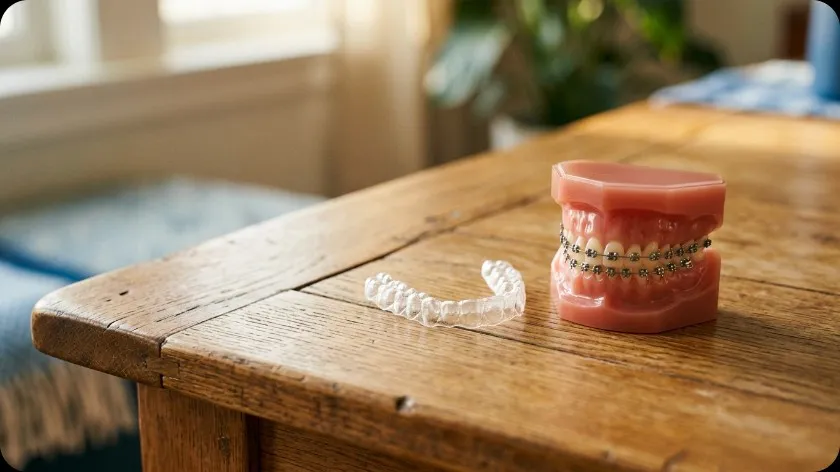
Traditional braces use metal or ceramic brackets bonded to each tooth, connected by a wire that your orthodontist tightens periodically. That gradual tension moves your teeth into position over time. Braces are fixed in your mouth for the duration of treatment, you don't take them out, and adjustments happen in-office every few weeks.
Invisalign (and other clear aligner systems) use a series of custom-made, nearly invisible plastic trays. Each tray in the series shifts your teeth slightly, and you move on to the next tray every week or two as directed. Unlike braces, aligners are removable, which is both their biggest selling point and, for some people, their biggest risk.
The use of Invisalign in orthodontics has expanded a lot over the past decade, partly because the technology for mapping tooth movement digitally has gotten more sophisticated, and partly because adults who didn't want visible metal brackets as teenagers are now seeking treatment as grown-ups with professional appearances to maintain.
Comfort and Daily Life
This is often where people's decision actually gets made, more than any clinical argument.
Braces can cause some soreness after adjustments, and the brackets and wires take some getting used to in terms of eating. Certain foods (sticky candy, corn on the cob, hard nuts) need to be avoided or eaten carefully to prevent broken brackets. Brushing and flossing require a bit more technique to get around the hardware. On the plus side, there's no discipline required since you're not responsible for taking anything in or out.
Invisalign trays are generally more comfortable day to day since there's no metal rubbing against your cheeks, though each new tray in the series can cause some pressure or soreness for a day or two as it starts working. You can eat whatever you want because you take the trays out at mealtime, which also makes brushing and flossing simpler since you're not working around hardware. The catch is that aligners need to be worn a specific number of hours a day, typically around 20 to 22, to stay on schedule. If you're someone who'll forget to put them back in after lunch, or who travels a lot and loses track of routines, that discipline requirement is worth being honest with yourself about.
What Each Can Actually Fix
This is the part where a real clinical evaluation matters more than personal preference. Traditional braces have historically been able to address a wider range of orthodontic issues, including more severe crowding, significant bite misalignment, and complex tooth rotations, because the fixed hardware allows for very precise, continuous force in multiple directions.
Invisalign and comparable aligner systems have improved substantially and now handle a wide range of mild-to-moderate cases very well, including crowding, spacing, and many bite issues. But for certain complex or severe cases, an orthodontist may still recommend braces, or a combination approach, because the physics of moving certain teeth is simply easier to achieve with fixed hardware.
This is genuinely not a decision to make from a blog post. An orthodontic evaluation, with x-rays and a look at your bite and jaw alignment, is the only way to know for certain which approach (or combination) will get you the result you want.
Treatment Time
People often assume aligners are automatically faster, but that's not a safe assumption. Treatment time depends far more on the complexity of your case than on which technology you use. Some straightforward cases finish faster with aligners because there's no need to wait for in-office adjustments, patients simply move through their tray series on schedule. Other, more complex cases may take just as long or longer with aligners compared to braces, or may not be appropriate for aligners at all.
Compliance also plays a bigger role in aligner timelines than in braces timelines, for the obvious reason that aligners can be taken out. Skipping hours or losing a tray can push your treatment timeline back in a way that simply doesn't happen with fixed braces.
Cost Considerations
Pricing for both options varies widely based on case complexity, your location, and your orthodontist's experience, so it's not something we can responsibly put a specific number on here. In general, simpler cases tend to cost less regardless of which technology is used, and complex cases cost more. Insurance coverage for orthodontic treatment, when available, often applies similarly to both options, though specifics vary by plan. The best way to get real numbers is a consultation, where your orthodontist can map out a treatment plan and give you a written cost estimate based on your actual teeth, not a hypothetical case.
So, Which One?
A reasonable starting framework:
- Lean toward braces if your case is more complex, you want a hands-off approach where you're not responsible for remembering to wear anything, or your orthodontist recommends it based on your specific bite.
- Lean toward Invisalign if your case is mild to moderate, you're motivated to follow the wear schedule consistently, and the appearance of metal brackets is a real concern for you professionally or socially.
Either way, the decision works best as a conversation with an orthodontist who's actually looked at your teeth, not a general comparison chart. Both approaches have a long track record of success when used for the right case and followed as prescribed. What matters most isn't which technology is trendier, it's which one fits your mouth, your habits, and your timeline realistically.
Find a dentist in your city
Browse verified clinics, compare services, and see which ones take new patients.
Find a clinic